
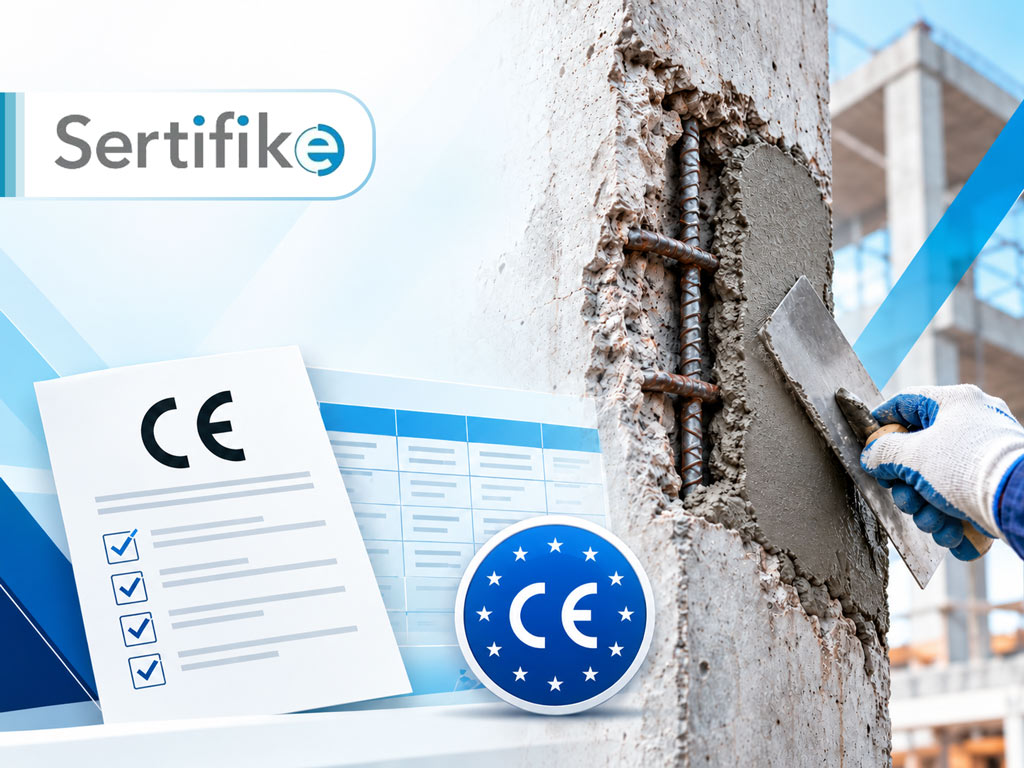
Products used for the repair and protection of damaged concrete in bridges, tunnels, parking structures, industrial facilities and buildings are placed on the market with CE marking under Regulation (EU) No 305/2011, commonly known as the Construction Products Regulation (CPR).
The relevant harmonised standards for these products are Parts 2 to 7 of the EN 1504 series. This guide explains the scope of each standard, the product categories covered, the essential characteristics declared in the Declaration of Performance (DoP), and the certification process under Assessment and Verification of Constancy of Performance (AVCP) System 2+.
At a Glance
Products covered by EN 1504-2 to EN 1504-7 are generally subject to AVCP System 2+ when intended for use in buildings and civil engineering works. The manufacturer determines the product type's performance, establishes and implements Factory Production Control (FPC), and prepares the Declaration of Performance (DoP). A Notified Body assesses the FPC system and issues a Certificate of Conformity of Factory Production Control. Certain characteristics and intended uses, particularly those related to reaction to fire, may be subject to different assessment systems.
Overview of the EN 1504 Series
| Standard | Product Category | Examples of Products |
|---|---|---|
| EN 1504-2 | Surface protection systems for concrete | Hydrophobic impregnation (H), impregnation (I), coatings (C) |
| EN 1504-3 | Structural and non-structural repair | Repair mortars and concretes: R4 and R3 (structural), R2 and R1 (non-structural) |
| EN 1504-4 | Structural bonding | Epoxy-based adhesives and products for bonding plates and reinforcement elements |
| EN 1504-5 | Concrete injection | Force-transmitting (F), ductile (D) and swelling-fitted (S) injection products |
| EN 1504-6 | Anchoring of reinforcing steel bars | Anchoring mortars and resins for reinforcement bars |
| EN 1504-7 | Reinforcement corrosion protection | Active coatings and barrier coatings |
Other parts of the EN 1504 series provide supporting requirements and guidance. EN 1504-1 defines terminology, EN 1504-8 addresses quality control and conformity assessment, and EN 1504-9 establishes general principles and methods for the protection and repair of concrete structures.
The principles outlined in EN 1504-9, such as protection against ingress, structural strengthening and preservation or restoration of passivity, provide a useful framework for understanding the intended function of individual repair and protection products.
Can a Product Fall Under More Than One Part of EN 1504?
Yes. For example, a polymer-modified repair mortar may be declared both as an R3 repair mortar under EN 1504-3 and as a reinforcement corrosion protection product under EN 1504-7, provided that it meets the applicable requirements of both standards.
In such cases, each intended use and the corresponding standard must be identified separately in the Declaration of Performance. The Factory Production Control plan must also include appropriate controls to support all declared performances.
Essential Characteristics Declared in the Declaration of Performance (DoP)
The characteristics to be declared depend on the applicable part of EN 1504 and the intended use of the product. For a repair mortar covered by EN 1504-3, typical characteristics include:
| Essential Characteristic | Description |
|---|---|
| Compressive strength | Minimum strength requirement according to the product class, with R4 having the highest requirement |
| Chloride ion content | Expressed as a percentage by mass |
| Adhesive bond strength | Tensile bond strength to the concrete substrate |
| Restrained shrinkage / expansion | Bond performance following restrained shrinkage or expansion |
| Resistance to carbonation | Particularly relevant to structural repair mortars |
| Elastic modulus | Applicable to structural repair mortars |
| Thermal compatibility | Freeze-thaw cycling, thunder-shower cycling or dry thermal cycling |
| Capillary absorption | Capillary water absorption coefficient |
| Reaction to fire | Product classification according to the Euroclass system |
| Dangerous substances | Requirements applicable at the place of intended use |
For surface protection products covered by EN 1504-2, other characteristics are particularly relevant, including water vapour permeability, CO₂ permeability, capillary water absorption, chemical resistance and crack-bridging ability.
For hydrophobic impregnation products, penetration depth and drying rate are important performance characteristics, while adhesion strength is particularly relevant to protective coatings.
AVCP System 2+: Responsibilities of the Manufacturer and the Notified Body
Under Assessment and Verification of Constancy of Performance (AVCP) System 2+, the manufacturer and the Notified Body have clearly defined responsibilities.
Manufacturer's Responsibilities:
- Determine the performance of the product type using the test methods specified in the applicable part of EN 1504.
- Establish, document and implement a Factory Production Control (FPC) system.
- Carry out testing of samples taken during production in accordance with the prescribed testing plan.
- Prepare the Declaration of Performance (DoP) and affix the CE marking.
Responsibilities of the Notified Body:
- Perform the initial inspection of the manufacturing plant and its Factory Production Control system.
- Conduct continuing surveillance, assessment and evaluation of Factory Production Control.
- Issue, restrict, suspend or withdraw the Certificate of Conformity of Factory Production Control, as applicable.
Under System 2+, the Notified Body is not responsible for performing product-type testing. The document commonly referred to as a "CE Certificate" in the construction products sector is the Certificate of Conformity of Factory Production Control, issued following the successful completion of the certification process.
The applicable AVCP system may vary depending on the product's intended use and specific essential characteristics. For example, products intended for applications subject to reaction-to-fire requirements may fall under different assessment systems.
The applicable system must be determined by consulting Annex ZA of the relevant harmonised standard. Sertifike's designation as a Notified Body is limited to AVCP System 2+.
Key Factory Production Control Requirements for Concrete Repair and Protection Manufacturers
- Raw material control: Acceptance criteria for cement, aggregates, polymers, resins and hardening agents.
- Multi-component products: Individual traceability of components such as resins and hardeners, together with accurate declaration of mixing ratios on product labels.
- Fresh product controls: Batch-specific checks covering consistency, density, workability and other relevant properties.
- Hardened product testing: Verification of declared characteristics, including compressive strength and adhesive bond strength, at the frequencies specified in the testing plan.
- Shelf life: Monitoring of storage conditions and shelf life, particularly for resin-based products.
- Multiple declarations: Ensuring that the FPC plan covers all declared performances when a product falls within the scope of more than one part of EN 1504.
Documentation Required Before Applying for Certification
Before the initial inspection, manufacturers applying for Factory Production Control (FPC) certification for concrete repair and protection products should have the following information and records available:
- A list of products to be included in the certification scope, specifying the applicable EN 1504 standard, product type or class (e.g., R4, H or F), and intended use.
- Product-type determination test reports for each product.
- Documented FPC procedures covering raw material acceptance, formulation management, batch identification, testing plans and frequencies, and the handling of non-conforming products.
- A list of testing and measuring equipment, together with relevant calibration records.
- Records demonstrating the individual traceability of components used in multi-component products.
- Draft Declarations of Performance and examples of product packaging labels.
Example of a CE Marking Label
Illustrative CE marking label – Structural Repair Mortar
CE · 3228
Example Construction Chemicals Ltd., [address]
26
DoP No.: EX-RM-001
EN 1504-3:2005
CC mortar (cement-based) for structural repair, Class R4
Compressive strength: ≥ 45 MPa (R4) · Chloride ion content: ≤ 0.05% · Adhesive bond strength: ≥ 2.0 MPa · Resistance to carbonation: [declared performance] · Elastic modulus: ≥ 20 GPa · Capillary absorption: ≤ 0.5 kg·m⁻²·h⁻⁰·⁵ · Reaction to fire: [class]
For illustrative purposes only.
Common Mistakes to Avoid
- Specifying a non-structural repair product classified as R1 or R2 for structural repair applications.
- Declaring a product under multiple parts of EN 1504 while including controls for only one standard in the FPC plan.
- Placing a product on the market for an application subject to fire regulations without declaring the required reaction-to-fire classification.
- Providing inconsistent mixing ratios for multi-component products between the product label and the Declaration of Performance.
- Confusing the repair principles defined in EN 1504-9 with the intended use declared in the DoP.
Frequently Asked Questions
Both R3 and R4 are classifications for structural repair mortars under EN 1504-3. R4 requires higher compressive strength, adhesive bond strength and elastic modulus. It is generally preferred for repairing structural elements subject to higher loads.
Hydrophobic impregnation penetrates the pores of concrete, making the surface water-repellent without forming a continuous film. A protective coating, on the other hand, creates a continuous protective layer on the concrete surface.
The requirement depends on the applicable AVCP system, which is determined by the product's intended use and relevant essential characteristics. For applications subject to System 2+, certification of Factory Production Control by a Notified Body is required. The applicable assessment system should be verified against Annex ZA of the relevant harmonised standard.
Yes, provided the product satisfies the applicable requirements of both standards. Each intended use must be identified separately in the Declaration of Performance, and the Factory Production Control system must support both declarations.
No. The product classification is determined through testing carried out under the manufacturer's responsibility and is declared in the DoP. The Notified Body assesses the Factory Production Control system to verify that the manufacturing process consistently maintains the declared performance.
Shelf life is not an essential characteristic required to be declared in the DoP. However, it is generally expected to be specified on the product packaging and in technical documentation, as it indicates the period during which the product retains its declared performance under appropriate storage conditions. Storage conditions and shelf-life controls are also assessed as part of Factory Production Control.