Differences Between the CE Mark and ISO Certificates – Which One Is Mandatory?
“Is the CE mark required? Or is an ISO certificate enough?”
Many manufacturers and importers confuse these two concepts, making it difficult to distinguish which one is mandatory and which one is optional.
In this article, we clearly explain the differences between the CE mark and ISO certificates, when they are required, and what they mean in terms of product safety.
What Is the CE Mark?
The CE mark is a LEGAL requirement indicating that a product complies with the European Union’s:
- Health
- Safety
- Environmental
- Performance
The CE mark:
- Is mandatory for placing a product on the EU market
- Shows compliance with relevant EU directives (LVD, EMC, MDR, Machinery Directive, etc.)
- Is not a certificate, but a declaration of conformity
- Is affixed directly to the product
In short: The CE mark is a legal confirmation of product safety.
What Is an ISO Certificate?
ISO certificates demonstrate compliance with management system standards published by the International Organization for Standardization (ISO).
Examples:
- ISO 9001 → Quality Management System
- ISO 14001 → Environmental Management System
- ISO 45001 → Occupational Health and Safety Management System
ISO certificates:
- Are issued to companies, not products
- Show that management systems operate properly
- Are generally not mandatory (with some sector-specific exceptions)
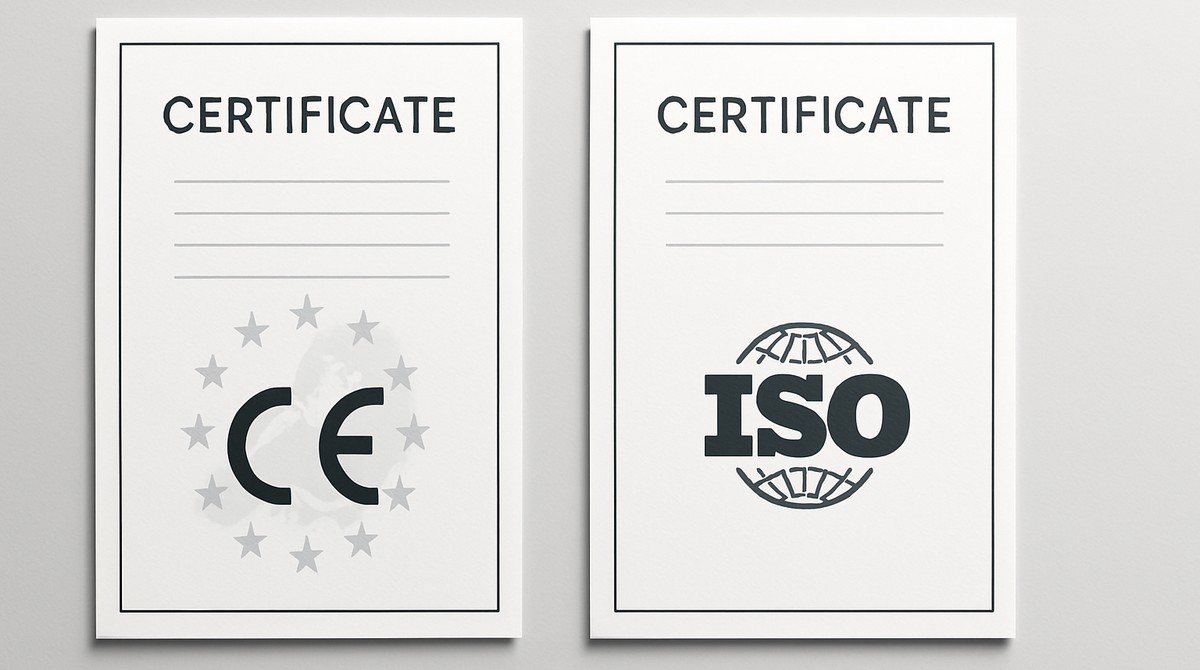
In short: ISO certificates prove how a company operates; the CE mark proves that a product is safe.
Key Differences Between the CE Mark and ISO Certificates
| Feature | CE Mark | ISO Certificates |
|---|---|---|
| Mandatory | Mandatory for many products | Voluntary |
| Scope | Product safety and performance | Company management system |
| Validity | EU market (legal requirement) | Global (market advantage) |
| Application | Marking on the product | Certification of the company |
| Document Type | Declaration of Conformity + tests | Certification after audit |
| Assessment | Product tests + technical file | Management system audit |
Is the CE Mark Mandatory or ISO?
The answer depends on the product type and the target market.
CE Mark Is Mandatory
The CE mark is legally required for products such as:
- Electrical products
- Machinery
- Toys
- Medical devices
- Personal protective equipment (PPE)
- Pressure equipment
- Construction products
- Gas appliances
Without the CE mark, products cannot enter or be sold in the EU market.
ISO Certificates Are Generally Not Mandatory
ISO certificates:
- Are not legally required
- Regulate company systems rather than product safety
- Increase market trust
- Provide a competitive advantage
Note: In some sectors (e.g., medical devices), standards like ISO 13485 may be mandatory.
Does the CE Mark Replace ISO Certification?
No. CE and ISO are not alternatives—they serve completely different purposes.
- CE → Shows that the product is safe
- ISO → Shows that the company’s system is well managed
Many companies use both: ISO 9001 structures the production process, while the CE mark confirms that the product itself is safe.
Risks of Misunderstanding CE and ISO
Common misconceptions:
- “I have ISO 9001, so I don’t need CE.” → ❌ Wrong
- “The CE mark is a quality certificate.” → ❌ Wrong
- “CE certification is issued to the company.” → ❌ Wrong
- “You cannot get CE without ISO.” → ❌ Wrong
These misunderstandings often lead to delays and incorrect CE applications.
How Does SERTİFİKE Support You?
As SERTİFİKE, during the CE process we:
- Clarify CE requirements for your product
- Identify necessary tests and methods
- Verify the correct use of the CE mark
This helps manufacturers and importers manage CE and ISO processes accurately and confidently.
Conclusion: CE and ISO Are Not the Same
The CE mark is a legal requirement for product safety.
ISO certificates are voluntary standards for a company’s organizational structure.
To sell a product in Europe, the CE mark is mandatory. ISO certificates do not replace CE, but they help strengthen quality management systems.