
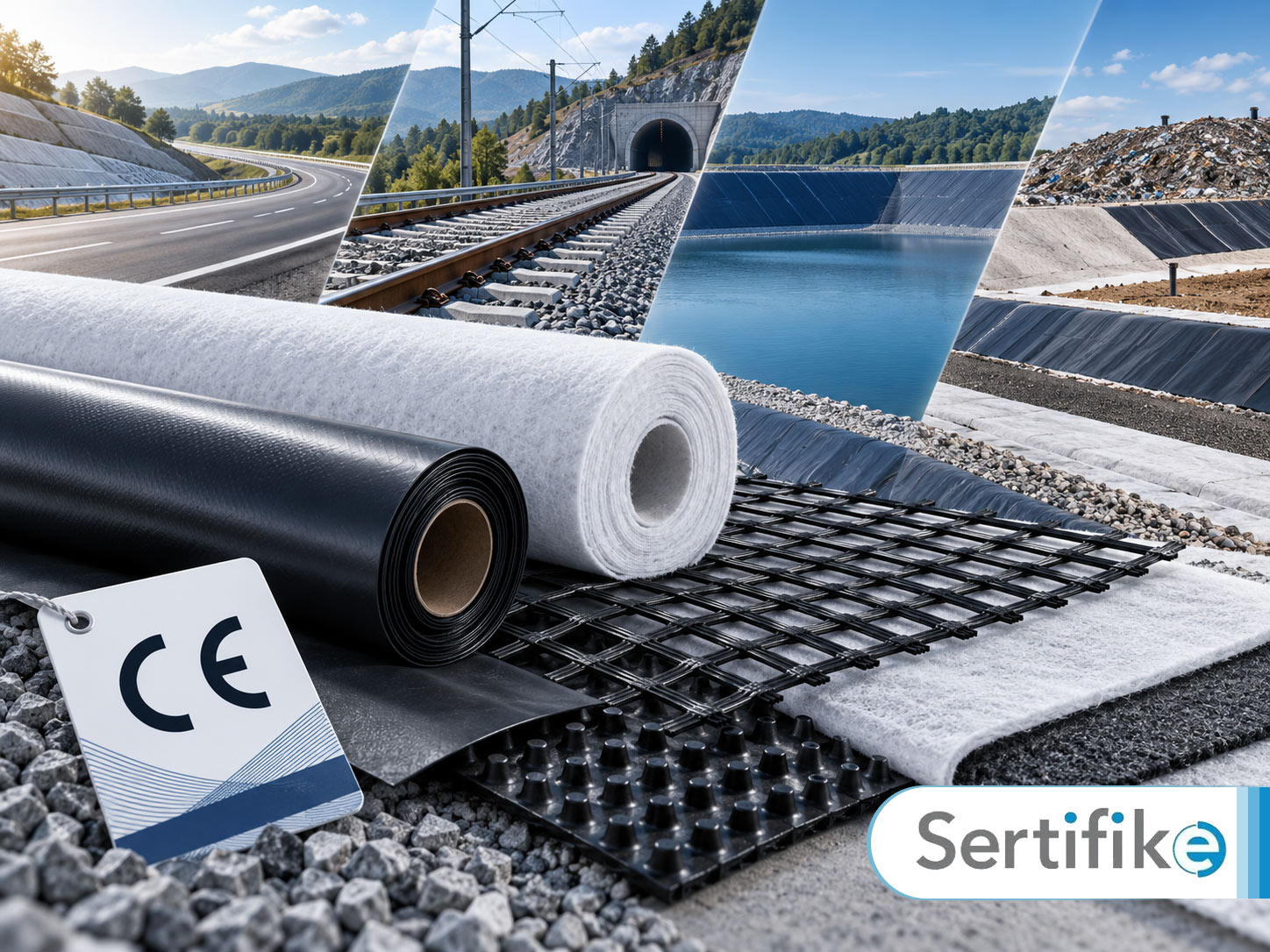
Geotextile CE Certification: EN 13249 & Geosynthetic Standards
Geotextiles, geomembranes, geogrids, geocomposites and geonets used in roads, railways, dams, canals, tunnels and landfill facilities are placed on the market with CE marking under Regulation (EU) No 305/2011, the Construction Products Regulation (CPR). Within this product family, the applicable harmonised standard is determined primarily by the intended application rather than the product type alone. This guide outlines the relevant standards, intended functions, essential characteristics declared in the Declaration of Performance (DoP), and the certification process under AVCP System 2+.
At a Glance
For geosynthetics, the applicable standard is determined by the type of construction work in which the product will be used, such as roads, dams, tunnels or waste containment facilities. The Assessment and Verification of Constancy of Performance (AVCP) system depends on the product's intended function. Sertifike provides Factory Production Control (FPC) certification under AVCP System 2+ for geosynthetics used as protective layers, for drainage and/or filtration, and as liquid or gas barriers.
Types of Geosynthetic Products
- Geotextile: A permeable polymeric textile manufactured in woven, nonwoven or knitted form.
- Geomembrane (Geosynthetic Barrier): A low-permeability sheet designed to prevent the passage of liquids or gases. It may be polymeric, bituminous or clay-based, including geosynthetic clay liners (GCLs).
- Geogrid: An open-grid structure primarily used for soil reinforcement.
- Geocomposite: A product combining two or more geosynthetic components, such as a geotextile and a drainage core.
- Geonet: A net-like structure formed from intersecting ribs, primarily designed for drainage applications.
Overview of Standards by Application
Standards applicable to geotextiles and geotextile-related products:
| Standard | Application Area |
|---|---|
| EN 13249 | Roads and other trafficked areas |
| EN 13250 | Railways |
| EN 13251 | Earthworks, foundations and retaining structures |
| EN 13252 | Drainage systems |
| EN 13253 | Erosion control works |
| EN 13254 | Reservoirs and dams |
| EN 13255 | Canals |
| EN 13256 | Tunnels and underground structures |
| EN 13257 | Solid waste disposal sites |
| EN 13265 | Liquid waste containment projects |
Standards applicable to geosynthetic barriers (geomembranes):
| Standard | Application Area |
|---|---|
| EN 13361 | Reservoirs and dams |
| EN 13362 | Canals |
| EN 13491 | Tunnels and underground structures |
| EN 13492 | Liquid waste disposal sites and transfer stations |
| EN 13493 | Solid waste storage and disposal sites |
| EN 15382 | Transportation infrastructure |
A separate standard, EN 15381, applies to geotextiles used in asphalt pavements. This standard is not included in Sertifike's current scope of notification as a Notified Body.
Where a product is intended for use in more than one application area, it must meet the requirements of the applicable standard for each intended application, and the relevant uses must be identified in the Declaration of Performance.
Why Is the Intended Function Important?
Geosynthetics perform different functions within construction works, including separation, filtration, drainage, reinforcement, protection and barrier functions. The essential characteristics declared in the DoP and the applicable AVCP system depend on these intended functions.
Sertifike's scope as Notified Body NB 3228 covers the following intended functions:
- Geosynthetics used as protective layers.
- Geosynthetics used for drainage and/or filtration.
- Geosynthetics used as liquid or gas barriers.
For other intended functions, the applicable AVCP system must be determined by reference to Annex ZA of the relevant harmonised standard.
Essential Characteristics Declared in the Declaration of Performance (DoP)
Typical characteristics for geotextiles and geotextile-related products include:
| Essential Characteristic | Test Method (Example) |
|---|---|
| Tensile strength and elongation at maximum load | EN ISO 10319 |
| Static puncture resistance (CBR) | EN ISO 12236 |
| Dynamic perforation resistance (cone drop test) | EN ISO 13433 |
| Characteristic opening size | EN ISO 12956 |
| Water permeability normal to the plane | EN ISO 11058 |
| In-plane water flow capacity | EN ISO 12958 |
| Durability (weathering, oxidation, etc.) | Relevant durability tests |
For geosynthetic barriers, key characteristics include watertightness, tensile properties, static puncture resistance, low-temperature behaviour and durability. The characteristics required for each intended function are specified in the relevant standard.
AVCP System 2+: Responsibilities of the Manufacturer and the Notified Body
Manufacturer:
- Determines the performance of the product type using the applicable test methods.
- Establishes, documents and implements Factory Production Control (FPC).
- Tests samples taken during production according to the prescribed testing plan.
- Prepares the Declaration of Performance and affixes the CE marking.
Notified Body:
- Performs the initial inspection of the manufacturing plant and Factory Production Control.
- Conducts continuing surveillance, assessment and evaluation of FPC.
- Issues, restricts, suspends or withdraws the Certificate of Conformity of Factory Production Control.
Under System 2+, the Notified Body does not perform product-type testing as part of its assigned certification responsibilities. The document commonly referred to as a CE certificate in the construction products sector is the Certificate of Conformity of Factory Production Control, issued following successful completion of the certification process.
Key Factory Production Control Requirements for Geosynthetic Manufacturing Lines
- Incoming polymer inspection: Acceptance criteria for polypropylene, polyethylene and polyester raw materials, including additives such as UV stabilisers and antioxidants.
- In-line measurements: Monitoring of mass per unit area, thickness and width.
- Finished product testing: Verification of declared characteristics, such as tensile strength, CBR puncture resistance and water permeability, at the prescribed testing frequencies.
- Declared values and tolerances: Evaluation of how mean values and tolerances are presented in the DoP and compared with FPC test results.
- Roll traceability: Identification of each roll by product type, production date and batch information.
- Durability: Ensuring that durability test evidence remains applicable to the product's intended service life.
Documentation Required Before Applying for Certification
A geosynthetic manufacturer applying for Factory Production Control (FPC) certification should have the following information and records available before the initial inspection:
- A list of products included in the certification scope, identifying the product type, intended function (protection, drainage/filtration or barrier) and applicable application standards.
- Product-type determination test reports and durability assessments for each product type.
- Declared performance values and tolerances.
- Documented FPC procedures covering polymer and additive acceptance, in-line measurements, testing plans and frequencies, and the handling of non-conforming products.
- Calibration records for measurement and testing equipment.
- Roll labelling and traceability procedures, together with draft Declarations of Performance.
Example of a CE Marking Label
Example Geosynthetics Ltd., [address]
26
DoP No.: EX-GT-001
EN 13249:2016 · EN 13251:2016 · EN 13252:2016
Nonwoven geotextile intended for filtration and protection in roads, earthworks and drainage systems.
Tensile strength: [declared value] kN/m · Elongation at maximum load: [declared value] % · Static puncture resistance (CBR): [declared value] kN · Characteristic opening size: [declared value] µm · Water permeability normal to the plane: [declared value] m/s · Durability: [declared performance]
For illustrative purposes only.
Common Mistakes
- Declaring a product intended for multiple application areas under only one standard.
- Failing to specify the intended function, such as protection or drainage, in the DoP.
- Declaring performance values without the applicable tolerances.
- Failing to relate the durability declaration to the intended service life.
- Declaring a product intended for use as an asphalt interlayer under EN 13249, although the applicable standard for this use is EN 15381.
Frequently Asked Questions
The applicable standard depends on the type of construction work in which the geotextile will be used. For example, EN 13249 applies to roads, EN 13250 to railways and EN 13252 to drainage systems. Where a product is intended for multiple application areas, more than one standard may be declared, provided the relevant requirements are met.
Geosynthetic barriers are assessed according to their intended application. EN 13361 applies to reservoirs and dams, EN 13362 to canals, EN 13491 to tunnels, EN 13492 and EN 13493 to waste containment facilities, and EN 15382 to transportation infrastructure.
The requirement depends on the AVCP system applicable to the product's intended function. Sertifike provides FPC certification under System 2+ for geosynthetics used as protective layers, for drainage and/or filtration, and as liquid or gas barriers.
No. Under AVCP System 2+, product testing is the responsibility of the manufacturer. The Notified Body verifies that the required tests are carried out according to the FPC plan and that the results are appropriately evaluated.
Yes. If the product meets the requirements applicable to both intended functions, both may be specified in the Declaration of Performance. The FPC plan must also include controls supporting each declared function.